Altcraft Docs LogoAltcraft Docs Logo
User guide iconUser guide
Developer guide iconDeveloper guide
Admin guide iconAdmin guide
English
  • Русский
  • English
Login
    User documentationGetting StartedFAQAltcraft glossaryPlatform limits
      Profiles and databasesarrow
    • Subscription resourcesManaging databasesSubscriber profileProfiles import and data updateCommon Errors When Importing ProfilesScheduled customer data importManaging Data TablesAutomatic data collectionBulk customers profiles updateDouble opt-in subscriptionSuppression listsProfile relationsProfile history exportProfile exportCreating a static segment based on import resultsHow to open a CSV fileMatchingTypes of fields in the databaseGlobal control groupsSubscription Manager
      Communication channelsarrow
      • Email channelarrow
      • Email: ISP interactions best practices
          First mailingarrow
        • Quick StartEmail
        Email: sending domain configurationEmail: setting up and using postmastersHow email tracking works
        Push Channelarrow
        • Mobile Pusharrow
        • First Mobile Push Mailing
            Mobile Push Providersarrow
          • Firebase Cloud MessagingApple Push Notification ServiceHuawei Mobile ServicesRuStoreYandex.AppMetrica
          Integrate your app with Altcraft
            Deprecated: Manual Push Setuparrow
          • Deprecated: Setup and ConnectionProcessing and adding a subscriptionEvent registrationProviders: push message structure
          Web Pusharrow
        • First Web Push MailingResource and Website Setup
            Web Push Providersarrow
          • Firebase Cloud messagingApple SafariMozilla Services
          Transferring Data to the PlatformWeb Push SDK MethodsPWA and Push Notifications
            Migration and Subscription Transferarrow
          • Migrating push subscriptions from third-party servicesHow to transfer push subscriptions configured for Safari?Migration from OneSignal
        Push token deactivation
        SMS channelarrow
      • SMS
        In-Apparrow
      • First In-App PlacementSDK Setup and IntegrationIn-App Cases
      WhatsAppViber*™
        Telegramarrow
      • Telegram BotTelegram Group
        Maxarrow
      • MAX BotMAX Group
      NotifyCommunication Channels WorkflowРуководство: SMS-рассылка через VK NotifyРуководство: SMS-рассылка через УТШРуководство: push-рассылка через сервис от "Согласие"
      Segmentationarrow
    • Static SegmentsDynamic SegmentsUpdatable Segments
        Segmentation Conditionsarrow
      • Segmentation by Profile dataSegmentation by Interactions with EntitiesSegmentation by Activity of the channel
          Segmentation by external dataarrow
        • Segmentation by external dataSegmentation by external SQL tablesRecommendations for segmentation by external data
        Segmentation by Profile structure
      Quick SegmentBest Send Time (BST)Logical operators "AND" and "OR"Recommendations for working with segments
      Message templatesarrow
      • Working with message templatesarrow
      • Working in the editorEmail templateSMS templatePush templateTemplate for In-AppMAX templateTelegram templateWhatsApp templateViber templateNotify template
        Visual editor for email-templatearrow
      • Visual editor interfaceAdding blocksElements and their settingsCustom blocksElement stylesLayer manager
      Template fragmentsImage galleryContent personalizationCreating tables based on array elementsBlock editor for email template
        Altcraft Variables and Functionsarrow
      • Logical expressions in messagesLoops in messagesMarket variables in templatesUsing the JSONPath functionality
        Dynamic content in messagesarrow
      • Dynamic HTML contentDynamic JSON contentContent from SQL database in templatesDynamic API contentMoodRec recommendations in messages
      Importing and exporting a message templateImporting a template from a third-party serviceExporting a template from Pixcraft
      Mailingsarrow
    • Broadcast mailingsTrigger mailingRegular mailingMultivariate testingMailing testingMailing schedulePlacementsMailings calendarMailing log — errors and troubleshootingManaging the Sender Queue
      Automation scenariosarrow
    • Managing scenariosScenario NodesClassic marketing scenariosStep-by-step welcome scenario guideScenario for automatic notification of the managerAbandoned cart scenarioCycle Handling in Automation ScenariosHigh-priority scenarios
      Campaignsarrow
    • Working with CampaignsLocal control groups (LCG)Stratification violation error when limit is reachedAudience expansion in campaignsAudience building
      Marketarrow
    • Market settings
        Productsarrow
      • How to create a product manuallyHow to import a product from a fileScheduled product importProduct and SKU SegmentsPreparing the YML file
      OrdersMarket variables in message templateGuide: how to send an order confirmation email
      Loyalty programsarrow
    • Loyalty programsLoyalty integration with external systemsCreating a loyalty program from scratchBasic loyalty program use casesOrder SegmentsPromotion codes
      Reports and analyticsarrow
    • Channel reportTraffic report
        Summary reportarrow
      • Summary report metrics
      Cohorts reportLifetime reportFunnels reportGoals reportAudience growth reportClick map reportLoyalty programs reportBounces reportUndeliveries reportReport on global control groups
      Weblayersarrow
      • Formsarrow
        • Create a formarrow
        • General settingsForm customization with custom codeForm constructorAppearanceActions and form publicationConditional logic in forms and surveys
        Data analyticsBinding data channel and formsNPS testing
        Pixelsarrow
      • Goal customer actions and scoring
        Pop-upsarrow
      • Creating and publishing a pop-upSetting up a popup in the code editorManaging pop-ups manually via scriptPopup analyticsGuide: pop-up for push subscriptionsCase: Creating a pop-up with the "Wheel of Fortune" widgetBasic cases of placing a popup via the Tag Manager
        Tag Managerarrow
      • Configuring and installing Tag ManagerTrigger typesVariable typesLinking a pixel and the Tag manager
      Settingsarrow
    • Account settingsCustom linksVirtual sendersSending policiesAudit journalTags FAQ
        Connectionsarrow
      • Connection to Facebook AdsConnection to Google AdsConnecting to Yandex.Audience™Connection to 360dialogConnection to EdnaConnection to Devino TelecomConnection to SMSTrafficConnection to VK Ads™Connection to MTS OmniChannelConnection via OAuth 2.0Basic Authentication connectionToken Authentication connectionCustom Authentication ConnectionConnecting to MAXConnection to NotifyConnection to Rapporto
        Users, groups and accessarrow
      • Password and login securityTwo-Factor Authentication (2FA)
      Attribute settings
      Integrationsarrow
    • Facebook Ads Manager
        Yandexarrow
      • Yandex AppMetricaYandex.Audience™
      Google Ads AudiencesWhatsAppStatic segment synchronizationViberVK AdsNotifyMAX
        Action hooksarrow
      • Lpgenerator™Tilda™Altcraft Action HooksAction hooks event typesEvent Capture Message StructuresJSON batch request (HTTP POST action hook)Message to RabbitMQ brokerMessage to RabbitMQ exchangerMessage to Kafka brokerTest event
        Integration of third-party services using Albatoarrow
      • Connecting Altcraft to Albato Launching the welcome scenario using AlbatoTransmitting event dataSetting up a trigger mailingEvent registrationGoogle Sheets and Altcraft integration AmoCRM and Altcraft integration
        Additional Informationarrow
      • Integration scopeData Transmitted During Synchronization
      API requests: where to startarrow
    • Import or update a profileTrigger mailing launchEngage profile in scenario
      Changelogarrow
    • v2026.3.79v2026.3.78v2026.2.77v2026.1.76v2025.4.75v2025.4.74v2025.3.73v2025.2.72v2025.1.71v2024.4.70v2024.3.69v2024.2.68.2v2024.1.68
    Documentation archiveEmail Marketer's Library
  • Message templates
  • Working with message templates
  • SMS template

SMS template

This article describes how to create a message template to send via SMS channel.

Message body​

Enter the text of the short message in the input field. Links, UTM tags and variables can be used in the message body:

Variables insertion button — menu of variables and functions the editor. Using this button, you can add customer profile data, promo codes to the message, loops and boolean expressions, as well as dynamic content and system links.

Insert link button — link editor.

UTM tags button — setting UTM labels.

SMS message body input field

MMS content​

The SMS channel supports MMS — messages with media content. Unlike a regular SMS, which consists of text only, an MMS contains both text and an image. Currently, MMS is available only via the MTS OmniChannel gateway.

The template mode is selected with a switcher on the SMS tab: SMS, MMS, or SMS and MMS.

MMS​

In the MMS mode, only MMS messages are sent — text with an image.

When the mode is selected, the following fields appear on the tab:

  • MMS message text — the text of the MMS message. Variables, links and UTM tags work the same way as in SMS.
  • Image in MMS — an image from the gallery or an uploaded file. Formats: .jpg, .jpeg, .gif; up to 800 KB; resolution up to 1024×1024.
  • MMS parts limit — if the resulting number of MMS parts exceeds the specified limit, the message will not be sent. Same as the SMS parts limit.
  • Add "http(s)://" to tracking links — automatic protocol insertion in MMS text links.
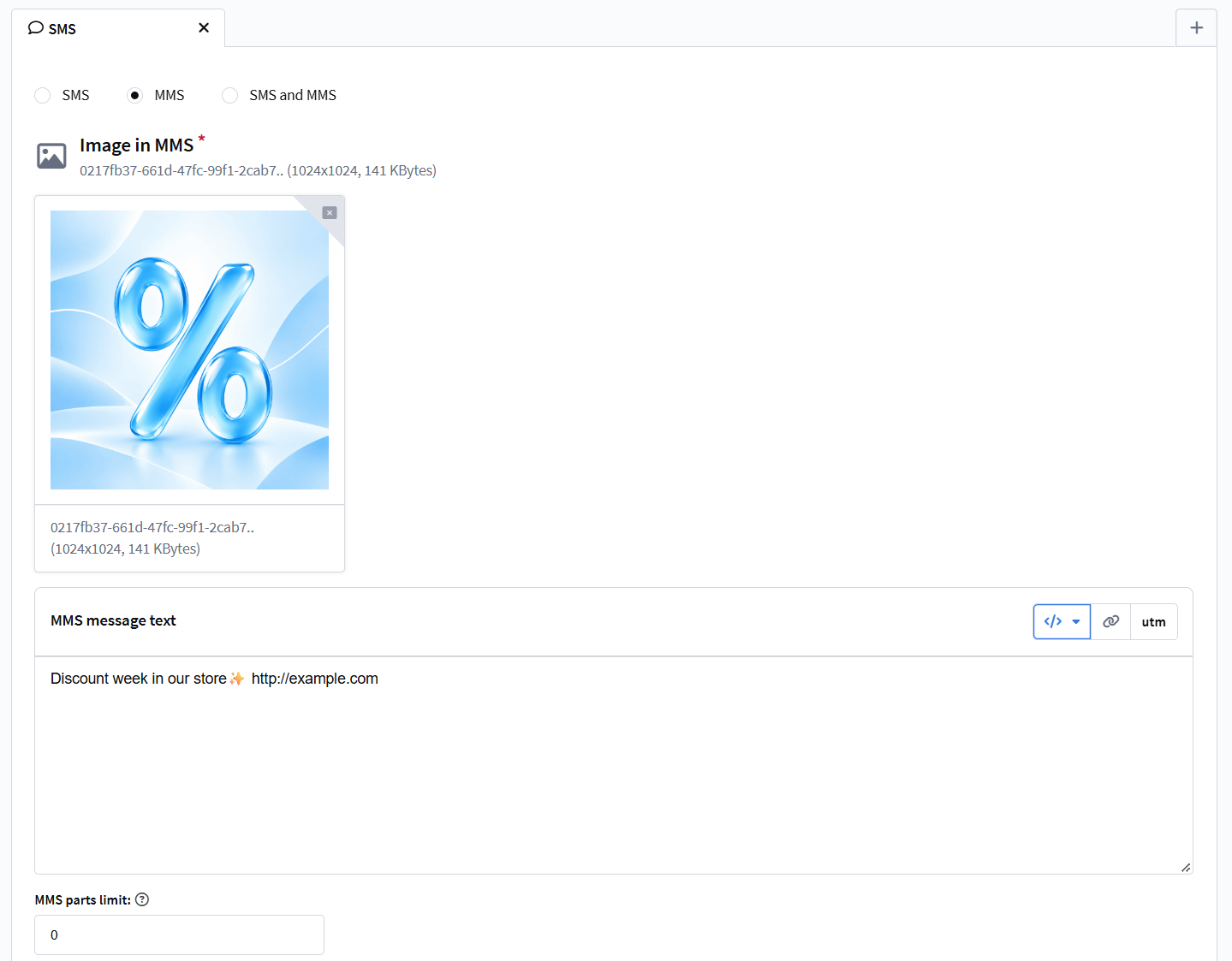
MMS template editor with image and text

The image and the MMS text are required: the template will not be saved if they are empty.

SMS and MMS​

In the SMS and MMS mode, both message versions are sent to the gateway (cascade). The delivery order is configured in the MTS OmniChannel personal account: for example, SMS first, and if it is not delivered — then MMS.

The cascade is useful when not all subscribers' devices support MMS: part of the base receives the image, while the rest get a regular SMS.

Both versions are filled in the same template: the SMS text in the regular tab field, and the MMS fields as in the MMS mode.

For example, an online store announces a sale. Both versions are filled in the template: the SMS is a short text with a promo code, and the MMS is the same text plus a sale banner image. The delivery decision is made by the provider based on its own logic: some subscribers get the MMS with the banner, others get the SMS with the promo code. In this case, the message is delivered to the subscriber in either SMS or MMS format.

In preview mode, both SMS and MMS versions of the message are displayed.

MMS limitations​

ParameterValue
Text with an imageup to 335 characters
Text without an imageup to 2000 characters
Image.jpg, .jpeg, .gif formats, up to 800 KB
Image resolutionup to 1024×1024

The platform checks the format, size and resolution of the image when it is added to the template. If the text exceeds the allowed limit, the message is not delivered — the campaign report and the profile card show a non-delivery.

SMS link editor​

tip

Links inserted through the platform are automatically shortened. The final link path (excluding tracking domain) length is 12-14 characters, including the /.

The link editor is available by clicking on the button Insert link. If you want to edit a link that has already been added to the template, select it in the editor and then open the form:

Selected link and Insert link button in SMS editor

One type of links is available for SMS messages. It is a custom link. It allows you to add a link to any web page.

Insert link dialog with custom link type

General​

In the general settings enter the URL to go to. Also specify the name, which is used in reports, segmentation and when launching triggers and scenarios. The link name can only consist of numbers and Latin letters.

caution

Please note that when you select profiles by clicking on a link in an SMS, you must specify the link name, not the URL, in the selection conditions.

Link name example in SMS

Additionally, you can disable redirection to tracking when clicking on the link, as well as make any link a subscription confirmation link.

Parameters in angle brackets example

In SMS messages, angle brackets are used to indicate parameters (for example, <name=""> will be used for the name parameter). Everything you specify in angle brackets will not be included in the final message. Usage examples:

  • <no-track> — disables redirection to tracking when clicking on a link.
  • <confirm-link> — makes a confirmation link.
  • <name="example_name"> — sets the name of the link.

UTM marks​

For each individual link in the message, you can override the UTM tags. To do this, go to the UTM tab and activate the Add UTM marks.

Variables can be used as labels, such as the name of the mailing or databases.

UTM tags in SMS link

Deep link​

If you want to use the SMS link to go to the mobile application, activate the option This is a new deep link on the corresponding tab.

To specify different links for Android and iOS platforms, add legacy deep links. Please note that such links can only be added using tracking.

Deep link and legacy links settings

Limit on the number of characters​

When sending SMS messages, it is important to take into account the length of the text, since the number of characters affects the cost of sending. One SMS message in Cyrillic can contain up to 70 characters and in Latin the are 160 characters, including spaces and punctuation marks. If you exceed these limits, your message will be charged as two SMS. The presence of at least one Cyrillic character makes the entire message Cyrillic.

The editor automatically counts the number of characters and messages. To see the counter, save the template and switch to preview mode:

Character and message counter in preview

tip

Please note that the data that is pulled from dynamic variables may exceed the expected number of characters.

The excessive sending can be restricted by specifying a value in the "SMS parts limit" field. If the message text exceeds the specified SMS parts limit after splitting, the message will not be sent at all. For example, if a user sets the limit to 3 SMS and the text length is 250 characters, no part of this message will be sent during the mailing..

SMS parts limit field

In addition, the http(s):// protocol is not added to the template to shorten links, but you can enable auto-substitution. This only applies to tracking links.

Notice

When a template includes logical expressions or loops, the platform counts every formatting character — spaces and line breaks — as part of the final message. Each space or line break adds one character to the SMS and may affect the cost. To save characters and control message length, keep logical constructions on one line.

For example, instead of:

{if lead._city equal "Moscow"}
We invite you to a conference in Moscow on June 30!
{else}
We invite you to a conference in your city!
{end}

SMS template with multi-line logic expression

Use:

{if lead._city equal "Moscow"} We invite you in Moscow on June 30!{else}We invite you in your city!{end}

SMS template with single-line logic expression

This approach keeps the logic intact and avoids unexpected SMS length growth.

Last updated on Nov 5, 2026
Previous
Email template
Next
Push template
  • Message body
  • MMS content
    • MMS
    • SMS and MMS
    • MMS limitations
  • SMS link editor
    • General
    • UTM marks
    • Deep link
  • Limit on the number of characters
© 2015 - 2026 Altcraft, LLC. All rights reserved.